Guides
One week in Kyrgyzstan: what fits
Seven days covers the eastern end of Issyk-Kul, one high day on foot, the quiet southern shore and two nights in a yurt camp on Song-Kul, and trying to add the south turns it into a driving holiday.
Seven days is the shortest stay that reaches more than one kind of country: the eastern end of Issyk-Kul, one high day on foot, the quiet southern shore and two nights on the pastures at Song-Kul. Kyrgyzstan is small on a map and long on the road, and a week that tries to add the south as well turns into a week in a car. The route below is the one we publish as the seven-day classic.
The route, day by day
- Day 1. Land in Bishkek. Draw cash, buy a SIM, sleep low before going high.
- Day 2. East along the northern shore to Karakol, 398 km and about six and a half hours.
- Day 3. The long walk up the Karakol gorge towards Ala-Kul, or an easier day at Jeti-Oguz.
- Day 4. Up the track to the hot springs at Altyn-Arashan: 30 km, about three hours in an old 4x4.
- Day 5. West along the southern shore for the Barskoon waterfalls and Skazka canyon.
- Day 6. The back road to Kochkor, then the Kalmak-Ashuu pass and a yurt camp on Song-Kul.
- Day 7. Down to Bishkek, with Ala-Archa added if you leave the lake early.
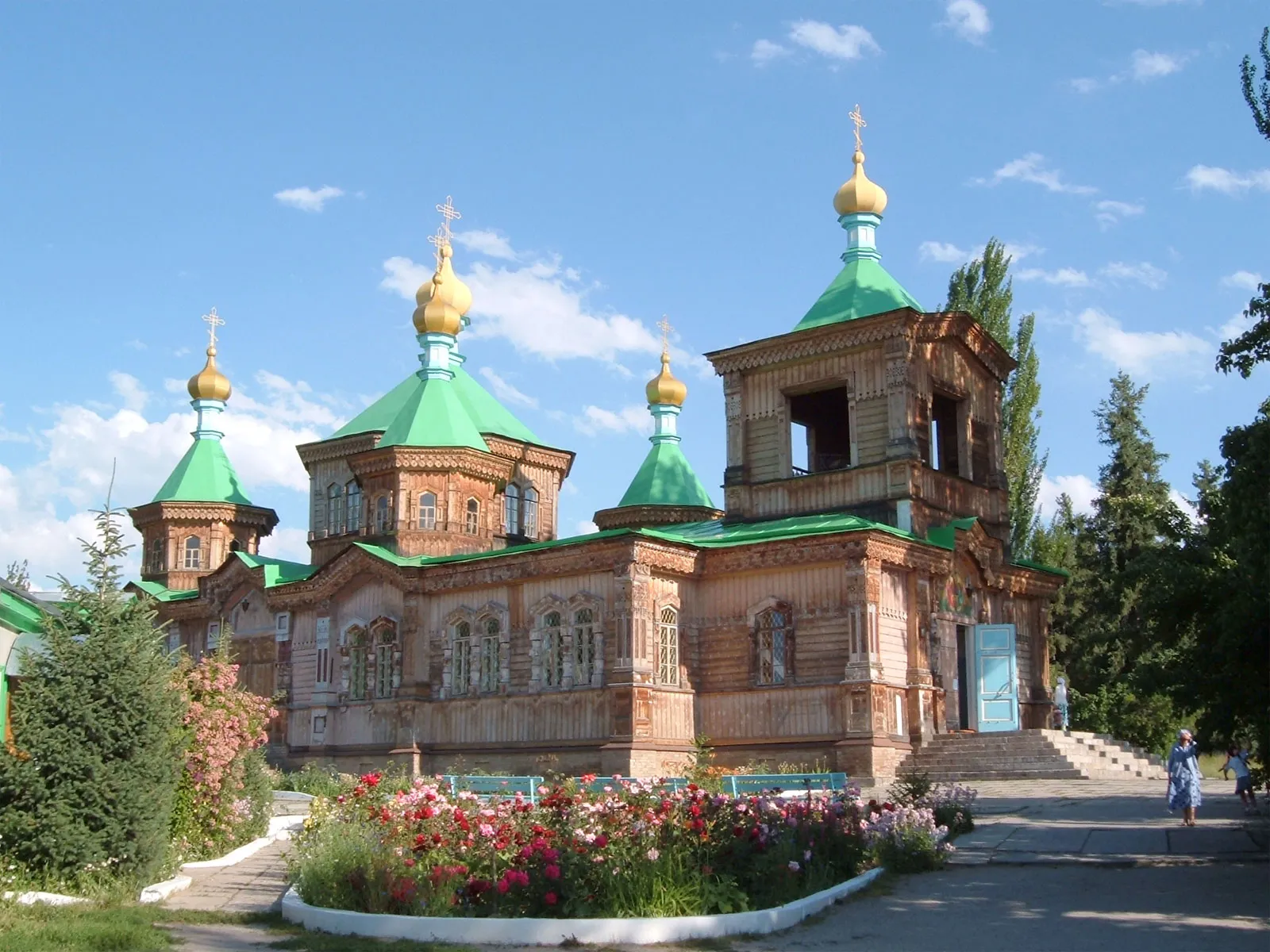
Karakol is the hinge of the week: Ala-Kul, Altyn-Arashan, Jeti-Oguz and the Barskoon gorge all sit within a morning of it, which is why three of the seven nights belong there.
What it means behind the wheel
Day two is 398 km of paved road through a string of villages with speed limits and radar, so allow more than the distance suggests. Day six adds up: 34 km from the canyon to Bokonbaevo, 118 km and two and a half hours to Kochkor, then 90 km and three hours of gravel over a pass at 3,446 m, close to six hours in all. Day seven is 300 km and about seven hours back to the capital, so Ala-Archa, 40 km out of Bishkek, only fits if the morning starts early.
If you have five days, or three
Take the days out of the middle, not the ends. With five days the lake alone makes a complete trip and Song-Kul comes out: that is the five-day Issyk-Kul loop, Bishkek to Cholpon-Ata in about four hours, then Karakol, the springs and the southern shore. With three days, keep only the pastures: three days at Song-Kul. Lose one day out of seven and it is the Ala-Kul walk that goes, not the yurt night: it is the most weather-dependent part of the week.
South instead of north
The week has a mirror image in the south, reached by the daily flight from Bishkek to Osh rather than the 680 km and twelve hours of road over the Too-Ashuu and Ala-Bel passes. A southern week covers Sulaiman-Too and the bazaar in Osh, the Alay valley under Lenin Peak, 220 km and four hours to Sary-Mogol and then an hour of gravel to Tulpar-Kul, and the walnut forest of Arslanbob, 185 km from the city. It is lower, hotter and less travelled; we run it as the southern seven days. The Alay valley is a border zone, so the permit has to be started weeks before you fly.
Walking instead of driving
Days three and four can become one trek instead of two drives. From the Karakol gorge it is 16 to 18 km and five to eight hours to the camp below the lake, then 600 to 1,000 m more to the water, the pass at about 3,900 m and a long descent into Altyn-Arashan: two or three days, with a night under canvas. A gentler version bases you at Jyrgalan, where the trails are marked and a village bed waits each evening. Trekking in Kyrgyzstan covers what each route asks of you.
When to come
This is a July and August week. The Ala-Kul trail is normally clear of snow from the start of July to mid-September, the Song-Kul camps run from about mid-June to mid-September, and the Kalmak-Ashuu pass is cleared at the end of May and shuts with the first snow around mid-October. June and September are quieter and colder. When to go works through the seasons.
Good to know
Questions travellers ask
- Is one week enough for Kyrgyzstan?
- It is enough for one half of the country done properly. A week takes in the eastern end of Issyk-Kul, a day in the high mountains, the southern shore and two nights at Song-Kul, and that is a complete trip rather than a sampler. What a week cannot absorb is the south as well, because the two halves are separated by a full day of road or a flight.
- Can I see both the north and the south in a week?
- Not in a way worth doing. Bishkek to Osh is 680 km and about twelve hours over two passes above 3,000 m, and even with the daily flight you lose most of two days to the transfer and arrive with four or five left. Pick one half for a week, and keep the other for a ten-day or two-week trip.
- How much of the week is spent driving?
- Three days carry most of it. The run to Karakol is 398 km and about six and a half hours, the day that ends at Song-Kul totals close to six hours with the last three on gravel, and the return to Bishkek is 300 km and around seven hours. The other four days are short hops of an hour or two between stops.
- Do I need a four-wheel drive for a seven-day route?
- For part of it. The lake shore and the road to Bishkek are paved and take an ordinary car. The track up to Altyn-Arashan and the Kalmak-Ashuu pass to Song-Kul both need four-wheel drive, so either the whole week runs on a 4x4 or those two sections are arranged separately with local vehicles.
- When is the best time for this route?
- July and August are the dependable weeks: the Ala-Kul trail is normally clear of snow from the start of July to mid-September, and the Song-Kul yurt camps run from about mid-June to mid-September. June and September are quieter but colder, and the Kalmak-Ashuu pass is only cleared at the end of May.
- Can Ala-Kul be done in a single day?
- Fit walkers with a guide and a vehicle transfer do reach the lake and return in one long day, and that is how it fits into a week. The unhurried version is a two- or three-day trek that crosses the pass at about 3,900 m and comes down into Altyn-Arashan, which replaces two driving days rather than one.
Guides
Read next
Ten days in Kyrgyzstan: north and centre
Ten days is where the country stops being a lake trip: the extra days buy the pastures of Song-Kul, the Naryn valley and the caravanserai at Tash-Rabat, with Issyk-Kul as the second half.
Two weeks in Kyrgyzstan: the whole country
A fortnight either covers the north without rushing anything, or splits into eight or nine days in the north and a flight south to Osh, the Alay valley and the walnut forest of Arslanbob.
Trekking in Kyrgyzstan: routes, seasons and altitude
Trekking in Kyrgyzstan, from a level river path in Ala-Archa to the pass above Ala-Kul at nearly 4,000 m: which routes suit which level, when the snow clears, and what the nights ask of you.
Your route is one conversation away
Tell us your dates, your pace and what you would like to see. We will put together a route from our own suppliers.