7 days
Classic Kyrgyzstan, 7 days
Karakol, Ala-Kul, Altyn-Arashan, the southern shore of Issyk-Kul and yurts at Song-Kul.
Seven days is the shortest route that takes in both halves of the country most people come for: the trekking valleys at the eastern end of Issyk-Kul, and the summer pastures of the interior. It suits travellers happy to spend one full day on a mountain trail, who do not mind a stove-heated yurt and a shared washroom. Five of the seven nights are under felt.
How hard it is
The demanding part is a single day: the climb from the Karakol gorge towards Ala-Kul at 3,560 m, walked with a guide after a transfer to the trailhead. Reckon on twelve hours out and back, most of it uphill and then steeply down. Say so in advance if that is more than you want, and the day can be spent instead on the Kok-Jayik meadows above Jeti-Oguz, where the ground is flat and the horses are local.
Driving is the other effort. Bishkek to Karakol is 398 km and about six and a half hours. The track up to Altyn-Arashan covers 30 km but takes three hours in an old 4x4 truck, over broken rock and river crossings. The climb to Song-Kul from Kochkor is 90 km and three hours of gravel over the Kalmak-Ashuu pass at 3,446 m.
Altitude and the nights
You sleep at 2,200 m in the Jeti-Oguz meadows, at 2,450 m in the hot-spring valley and at 3,016 m on the shore of Song-Kul, and the trekking day tops out above 3,500 m. Most people feel that as shortness of breath on the climbs and broken sleep on the first high night.
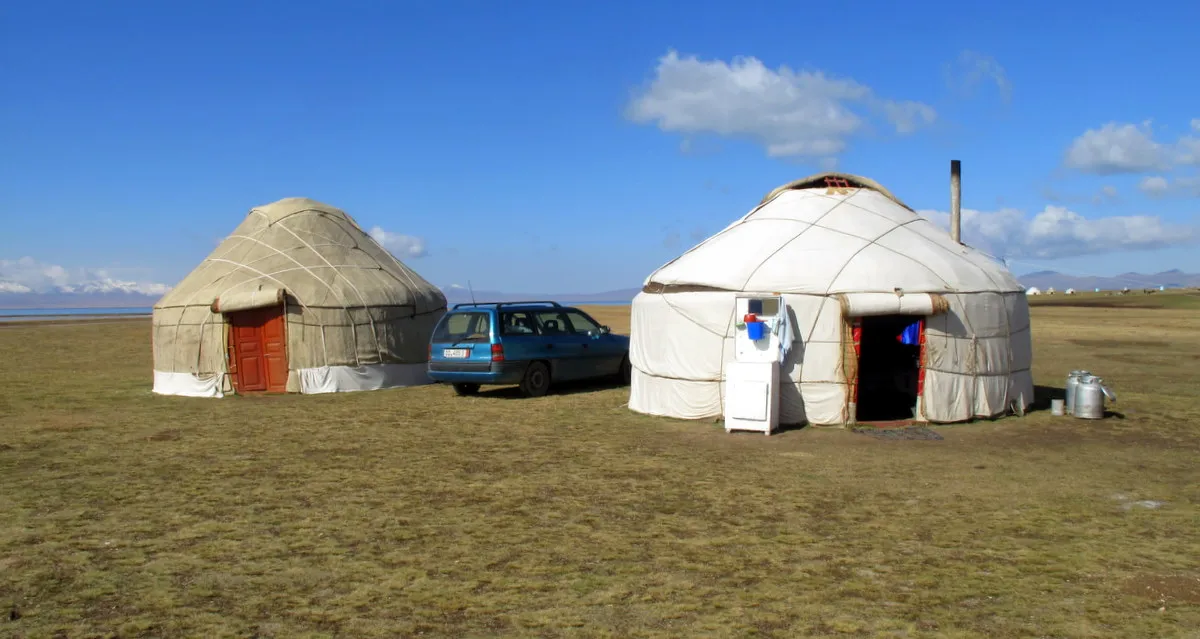
The yurts are felt walls, mattresses on the floor and a stove that has gone out by morning. There is no mains power at the lake or in the hot-spring valley, the toilet is outside and coverage comes and goes. The first and last nights are a hotel room in the capital. Carry cash in som: tickets, camps and drivers are all settled that way outside the city.
When it runs
July to mid-September is the window in which all seven days work. The Ala-Kul trail is normally clear of snow from the start of July into late September, and the lakeside camps stand from about mid-June to mid-September. Outside that it is the high ground that stops the route, not the main roads.
Changing it
Tell us what you want different and we rebuild the days around it: an extra night at the hot springs, the slower two-day crossing to Ala-Kul with a night on the trail, the loop run the other way, or the trekking day dropped for the south shore. Ask before you book, since most of the beds are in small family camps.
Day by day
The route
Day 1
Arrival in Bishkek
Overnight: Bishkek
- Bishkek: standard double room
- Car with driver, up to 4 passengers
Day 2
Bishkek to Karakol
Overnight: Jeti-Oguz
- Private transfer Bishkek to Karakol
- Kok-Jayik: night in a yurt with breakfast
Day 3
Trekking to Ala-Kul lake
Overnight: Jeti-Oguz
- Ala-Kul lake day trek with a guide
- Jeti-Oguz: bed in a shared yurt with breakfast
- Karakol national park entrance
Day 4
Altyn-Arashan hot springs
Overnight: Altyn-Arashan
- Altyn-Arashan hot springs access
- Altyn-Arashan: night in a yurt with breakfast
- 4x4 transfer Karakol to Altyn-Arashan
Day 5
South shore: Skazka canyon and eagle hunters
Overnight: Tamga
- Skazka canyon entrance
- Eagle hunter demonstration
- Tamga: bed in a shared yurt, half board
Day 6
Yurts at Song-Kul
Overnight: Song-Kul
- Song-Kul: full-day horse ride
- Song-Kul: lunch or dinner at the camp
- Song-Kul: bed in a shared yurt with breakfast
- 4x4 transfer Kochkor to Song-Kul
Day 7
Song-Kul to Ala-Archa and Bishkek
Overnight: Bishkek
- Ala-Archa national park entrance
- Bishkek: standard double room
- 4x4 with driver, up to 4 passengers
What the price includes
- —Seven nights: two in a Bishkek hotel, five in family yurt camps
- —Car, jeep and the 4x4 truck to the hot springs, all with a driver
- —Guided day trek to Ala-Kul and entry to Karakol National Park
- —A day on horseback on the summer pastures at Song-Kul
- —Hot spring bathing at Altyn-Arashan
- —Eagle hunter demonstration on the south shore of Issyk-Kul
- —Entry to Skazka canyon and Ala-Archa National Park
- —Breakfast daily, dinner on the south shore, one meal at Song-Kul
Not included
- —International flights to and from Kyrgyzstan
- —A visa, if your nationality needs one
- —Travel and mountain rescue insurance
- —Lunches and dinners not listed above, and all drinks
- —Personal spending, laundry and souvenirs
- —Tips for the driver, guides and camp families
On this trip
Places you stay
Good to know
Questions travellers ask
- How fit do I need to be?
- Fit enough for one long day on a mountain trail. The Ala-Kul day is roughly twelve hours of walking with a sustained climb above 3,500 m and a steep descent, and it is the only part of the week that asks anything of you. The rest is one to two hours at a time on easy ground. If that one day does not suit your party, tell us and we swap it for a valley walk and horses.
- How high does the route go, and will I feel it?
- The highest night is 3,016 m at Song-Kul and the highest point on foot is above 3,500 m at Ala-Kul. Most people notice the altitude as breathlessness on slopes and poor sleep on the first high night, which passes. The route builds up gradually, from 800 m in Bishkek through nights at 2,200 m and 2,450 m, which is the sensible way to do it. If symptoms build instead of easing, the answer is to lose height.
- What are the nights in yurts actually like?
- Felt walls, mattresses and thick blankets on the floor, a stove lit in the evening. Guests usually sleep several to a yurt. There is no mains power at Song-Kul or Altyn-Arashan, the toilet is a wooden one outside, washing is a basin or a bathhouse, and phone signal is unreliable. Nights fall close to freezing even in July, so bring a warm layer to sleep in.
- When is the best time to travel?
- July, August and the first half of September. The Ala-Kul trail is usually clear of snow from the start of July into late September, and the yurt camps at Song-Kul stand from about mid-June to mid-September. June is possible in a warm year but the high pass may still hold snow. From October the camps come down and the route no longer works as written.
- Can the dates or the itinerary be changed?
- The route is built for your party rather than sold as a fixed departure, so within the season the dates follow what suits you. Days can be swapped, nights added and the trekking day replaced. Once beds are held in small family camps, what can still be moved depends on the camp, so ask us about that when you enquire and we confirm it in writing before you pay anything.
- How much luggage can I bring?
- One suitcase or duffel plus a daypack per person is the practical limit, since cars and jeeps here seat four and the boot is not generous. On the trekking day you carry only a daypack with water, food and a warm layer. On the truck ride to the hot springs bags travel with you and get shaken about, so anything fragile is better left in the vehicle at Karakol.
Your route is one conversation away
Tell us your dates, your pace and what you would like to see. We will put together a route from our own suppliers.